
English Version | Portraits of an intimate space
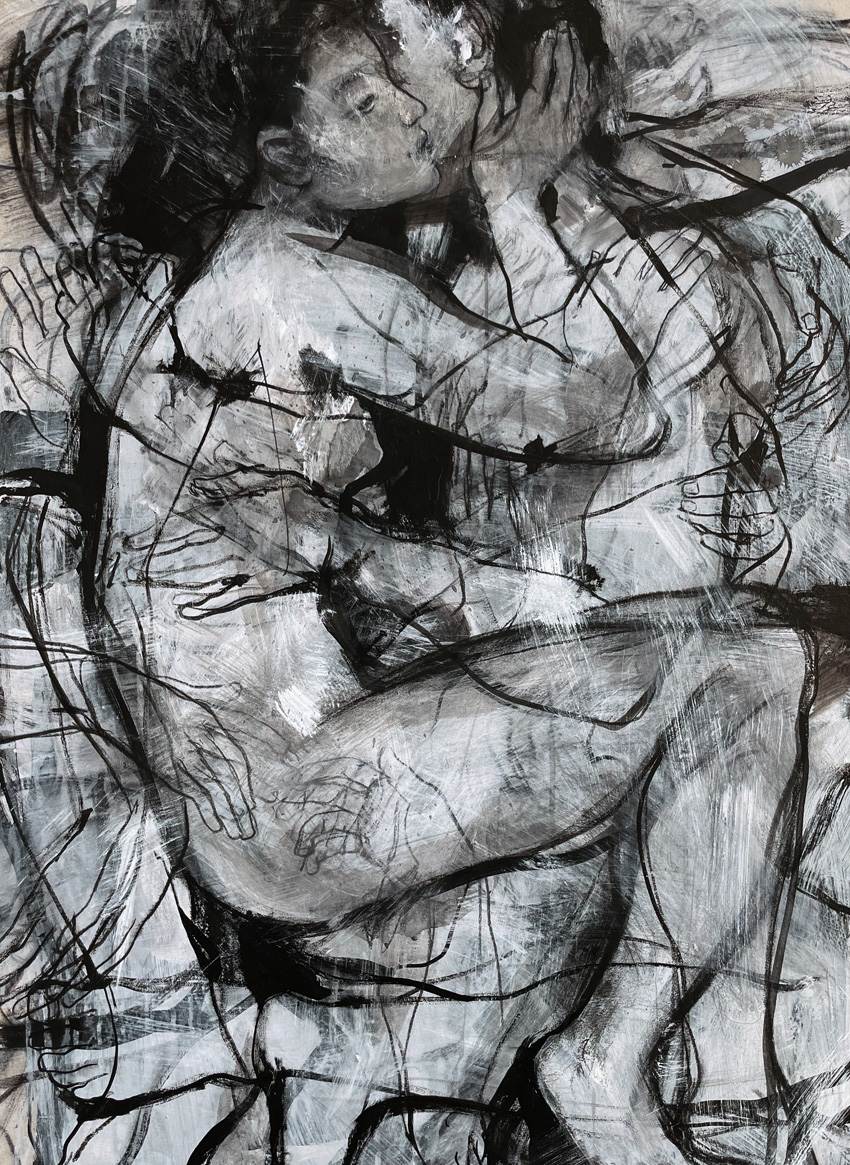
This is perhaps how we can describe Maria Naidyonova's paintings. Expressive and intense, her paintings stand as testimonies to human touch and intimacy, at a time when empathy and communication are increasingly scarce.
As a kind of primitive instinct, for some people, drawing and painting emerge as natural behaviours that manifest themselves from an early age. Seeing art as a means of giving shape to childhood fantasies, Ukrainian artist Maria Naidyonova — currently based in Berlin — finds in the canvas and brush tools to tell her story and develop an imaginary world rooted in people, their behaviours and their relationships. At the heart of her work is the quest to ‘see beauty in simple things.’ Because, rather than grandiose proclamations, it is the small moments — a brief gesture, a delicate glance — that emerge as intimate and meaningful testimonies of the human experience. By bringing initially private scenarios to life, Naidyonova draws on various artistic practices — oscillating between drawing, painting, abstraction and animation — to open up space for new conversations and invite us to explore a universe that exposes the way people interact with each other. Ultimately, her artistic vision is based on a sense of freedom, favouring a perspective that is faithful to the story and characters revealed by the painting. To find out more about her career, her relationship with art and her creative perspective, Vogue Portugal spoke to Maria Naidyonova in an interview that explains a little about what led her to build a body of work based on these themes.
How did art and drawing become part of your life?
I have been drawing since childhood, for as long as I can remember. It was my favourite pastime, as it allowed me to express all my fantasies. I imagined that everything I drew came to life and became real, and I found that incredibly fun — after all, that way, I could create anything I wanted!
Was it difficult to develop your own style?
Personal style develops over the years. It is a journey of deep experimentation, mistakes and discoveries. Furthermore, style can change as we ourselves change with age and experience. The subject of my work — people — is another matter entirely — it will always remain interesting to me.
What are your biggest influences and how have they changed over time?
I like many artists, but I especially admire Picasso. He inspires me greatly, both as an artist and as a person, due to his inexhaustible energy. A virtuoso of classical drawing, he did not limit himself to this, but neither did he reject it. By breaking, distorting and simplifying forms, changing styles and means of expression, he revolutionised art, combining tradition with innovation. And for this reason, he has always been my inspiration.
It talks about capturing moments with hidden meaning in everyday life. What exactly is this meaning you refer to?
This means seeing beauty in simple things — in everyday rituals, in a gesture, in a glance, in a pose, in the intertwining of fingers, in the tilt of the head, in the curve of the neck. Sometimes these moments can tell an entire story. They are natural, moving, a little mysterious, and always interesting.
In your earlier works, you tended to use a more vibrant and colourful palette, whereas now your compositions are based on softer tones. How and why did this change occur, and what does it mean in your work?
It's part of a natural creative process — a constant search for something new. When I was studying, I started with classical drawing, then moved on to painting and worked with layers of impasto paint, applying it generously to the canvas with a palette knife. Later, I discovered animation — a way to “bring my drawings to life”, as I dreamed of doing as a child. And after my “digital period”, I returned to canvas and paper. Now, my style combines elements of drawing, painting, abstraction and animation. And it can change as often as I change myself.
How does the combination of materials such as acrylic, pastel and charcoal help convey your message?
Technically, mixing materials creates an effect of depth, due to the different textures — soft with rigid, opaque with transparent, etc. In practice, I mix materials because I work quickly, conveying a certain feeling before it leaves me, and I use everything I have at hand that helps me achieve the desired effect. This approach creates a sense of spontaneity and ease. That is exactly the impression I want to convey.
How do your paintings explore human relationships, both physically and emotionally?
My works explore human relationships through their composition and colour. I focus on gestures, posture and the subtle distance or proximity between figures, because these visual elements often communicate the essence of feelings in a purer way than facial expressions.
What leads you to portray intimate acts and bring private spaces and moments into the public domain?
When I work, I don't think about the public at all. I don't perform on stage, but work privately in my studio and, essentially, paint for myself, due to the need to express myself. Later, when the work is finished and exhibited, it no longer seems personal or intimate to me. The connection to it is lost, it “lives” its own independent life.
Is your work rooted in personal memories and experiences, or do you develop your compositions through models and live drawings?
Both. I need people around me who inspire me. They are not models, but close friends, my muses. Observing people gives me ideas. However, when I am painting a canvas — this process comes after the sketching phase — I trust my personal intuition. Do you include yourself in your paintings? Emotionally — always; physically — never.
This month's edition of Vogue Portugal is dedicated to the theme of kissing. How important is this gesture in your work?
A kiss is undoubtedly a very important element of intimacy, but it does not need to be depicted literally, as in the works of Klimt or Rodin (which I love, by the way). Abstract lines and splashes of colour can also be used to convey the sensation of physical touch and kissing, the state of being in love. Many things in a painting can be perceived even if they are not directly illustrated.
As intimacy and kissing are recurring themes in your art, does this type of imagery also play an important role in your personal life?
Intimacy is a unique human experience. It reveals trust, vulnerability, and emotional connection. Although personal experiences inevitably shape an artist's perception, my work does not focus so much on documenting my own life, but rather on exploring universal human themes that resonate with many people.
Are there any real-life examples of kisses that continue to inspire you?
Of course! I love watching couples on public transport, in the streets, in parks and in cafés. Every stranger has their own story, their own life, their own drama, about which I know nothing. But by collecting images, one by one, of different characters, a whole story and a reason for painting emerges.
In your paintings, you often depict overlapping body parts. What is the reason behind this? Is it perhaps a way of conveying movement?
Yes, that comes from my experience with animation. In each frame, all movements are drawn by hand. Similarly, after the initial sketch, I begin to alter and rotate my characters, imagining how they would move in real life. I simply do not erase the previous lines, but leave the entire range of movement, from the first sketch to the final pose. This adds an element of dynamism, abstraction, and depth to the painting, superimposing blurred and sharp lines. It is enjoyable to work this way.
Given that your process is based on repetition and layering, how do you know when a painting is finished? Are you ever tempted to keep working on it indefinitely?
In contemporary art, everything is very subjective and there are no rules about how a finished painting should look. However, if you are a professional, your experience and intuition will always tell you when it is time to stop.
You usually work on a large scale. What attracts you to larger formats?
A feeling of freedom. The range of movement is completely different from that of small drawings (which I also enjoy doing). When working on a large canvas, it is not just the fingers that are involved, but the whole body. I also like the idea of monumental figures.
Is there any final message or feeling you would like viewers to take away with them after seeing your work?
I hope you relax a little and leave in a good mood.
Translated from the original in the Kiss Me Issue of Vogue Portugal, published March 2026. For full credits and stories, see the print issue.
Most popular
Chopard x Vogue Portugal: uma noite mágica na redação com a Torres Joalheiros
25 Sep 2026
 By Inaya Mussa
All articles
Relacionados
Rachel Scott sobre a Proenza Schouler: "Há um lindo legado aqui. Acho que tem de continuar a progredir"
03 Sep 2025