
English Version | Suspended poems
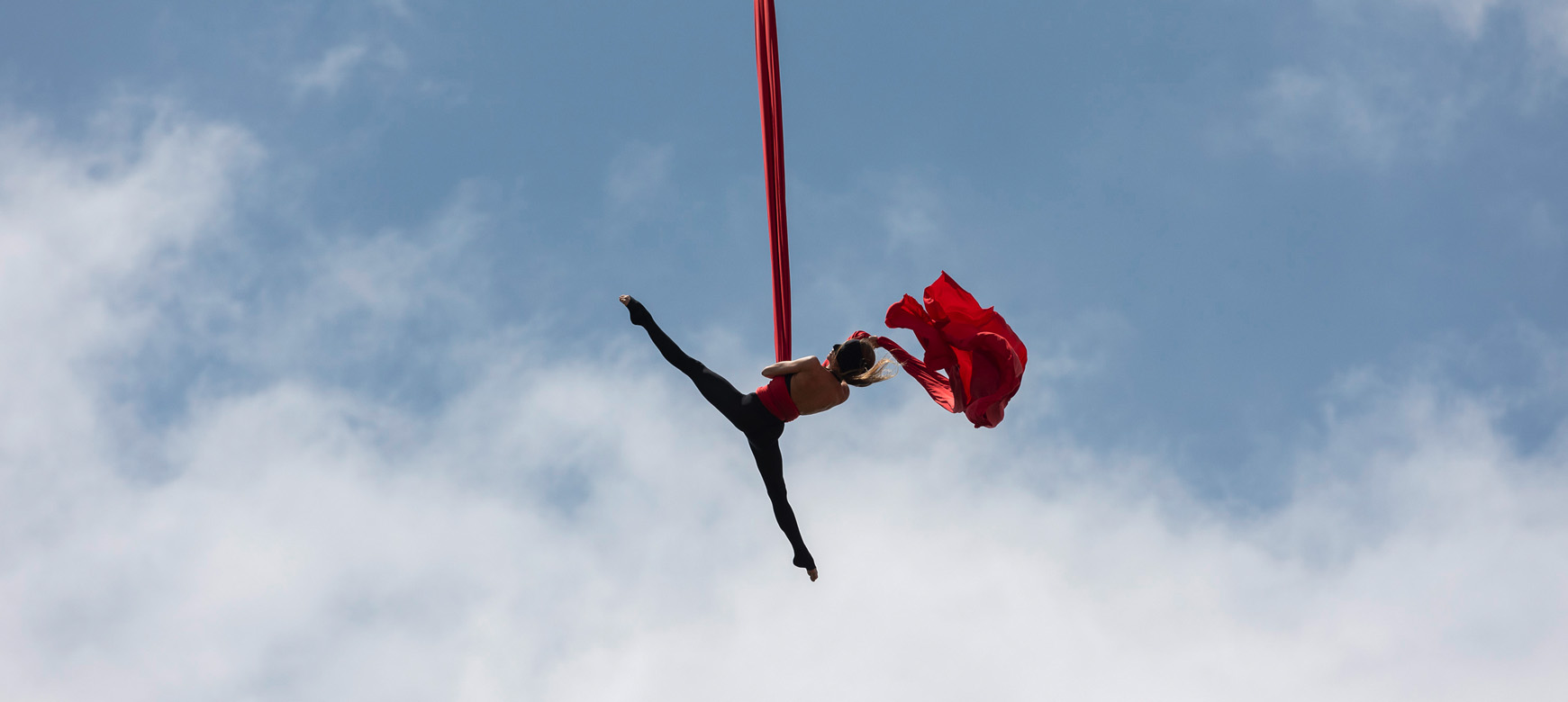
Living proof that boldness can take many forms, for artist Erika Lemay, the human body emerges as a vehicle for her artistic expression, challenging the possibilities of physics and exploring the limits of adrenaline.
For Erika Lemay, it is not writing, painting or music that allows her to express her creativity, but rather the manipulation of the human body's movement. Dedicated to her art from an early age – and to the way she uses her own body as an instrument – the Canadian artist seeks, in each project and performance, to challenge the limits of what is humanly possible, creating narratives through performances where acrobatics take centre stage. With a strong creative vision, expressed in a bold language that takes risks and provokes at every moment, Lemay has been developing what she calls physical poetry: an art form revealed through the human body. Here, words are set aside and movement takes centre stage.
How did sky dancing and this language of movement first enter your life?
I started ballet at four. A passion for movement, aesthetics and pushing the body to its limits was born, but after a few years I felt constrained in such a controlled field. I spent the next three years practising and competing in artistic gymnastics, where I was stung by the adrenaline of acrobatics. At 11, I entered the world of contemporary circus and was struck by something stronger and freer; it occupied my mind day and night; it felt limitless. By 13, I was touring the world with a professional Canadian contemporary circus company. After those teenage years on tour performing the creations of others, I felt a need for greater artistic flexibility to express my own visual language, so at 19 I left the company and started Physical Poetry®: a form of art in which the body writes what words cannot – acrobatics the medium, technique the grammar. The message leads; a visceral feeling should invade the spectator first, then the wow effect for difficulty and the visual storyline. For decades I trained eight hours a day to cultivate and refine the body’s possibilities for the language I wanted to use on stage.
You have been described as an “artist who makes gravity itself look optional”. Where does your drive to continuously exceed yourself and challenge the limits of human physics come from?
I can’t pinpoint that obsession to one moment. It applies to every side of my life. Somehow, I always end up putting myself in danger (metaphorically); otherwise it feels as if something is missing for me to breathe. I need to be fully stimulated, challenged and driven to thrive. It’s more of a personality trait than something acquired.
I was the same at four years old: I didn’t want to dance, I wanted to be the prima ballerina of the National Ballet. I didn’t want to be a gymnast; I wanted to go to the Olympics. I didn’t want to learn aerial arts; I wanted to fly higher than anyone had ever flown and, in the process, design a whole new artistic language.
I never felt my mind had any limits, but my body did, and that fascinated me. The human body and its hidden possibilities, both in performance and recovery, have always captivated me. During my studies at an art and acrobatic school in China, I watched middle-aged men who seemed far from athletic, balancing on two fingers; pure magic. That image stayed with me.
For the past 22 years, I have devoted myself to studying nutrition, neuroscience and all aspects of performance and recovery, long before "biohacking" became a trendy term, because I understood early on that this knowledge was the key to my ultimate dreams on stage and beyond. Following a major injury years ago, I founded the health company LEMAlab®, where I work with scientists to refine and share the performance blueprint I originally created for myself.
In 2022, you took part in America’s Got Talent: Extreme, where you received a unanimous golden buzzer. How did that moment feel?
It felt good, and I would never deny the power of recognition. Knowing it is one of the biggest performance TV shows on the planet. Yet external recognition is not what really leaves its trace on me. The most meaningful moments of my career are those when I hold a piece that I feel transcends every dream and goal; when, after endless fine-tuning, I feel I’m on the edge of touching the sublime. That is the true joy and the purpose behind the pain, exhaustion and lifelong dedication to my craft. It has been worth the toll on my body and health. I can bring myself to tears alone in a training studio after landing a line of aerial choreography I have dreamt of for decades. When the visual elements align and beauty becomes a kind of transcendence, it is worth more than a million applause. Then, of course, I want to share it with the world, but my motivation is passionately intrinsic.
At AGT: Extreme, I was unhappy with more than a few details: angles I wanted, moments the cameras could have caught better, small security choices and compromise for TV format. Instead of being elated by Simon Cowell’s validation, I found myself thinking about the craft. That is not ingratitude; I greatly appreciate the compliments and the support. I simply know it is my inner drive that carries me for years, often alone, through darkness and pain until the work finally lands.
Do you ever get nervous before your performances?
Not in the way people usually mean. I’m known to be strangely calm before stepping on stage, even for the biggest shows of my career. Years of practice taught me that nerves and stress make me less precise and less safe, particularly when I’m flying at 30 metres height. So I’ve learnt to quiet the feeling and hold my focus. Targeted meditation plays a part in that.
In every act, you seem to outdo yourself. How do you come up with new ideas for your productions and what is the process from conception to execution?
I have more ideas than a lifetime will let me put on stage. My inspiration rarely comes from my own field; it comes from philosophy, books, design language, thoughts and emotions, visual patterns, nature and writing. Images strike me, however impossible they seem, and they turn into obsessions. Each time I plan to rest, I find myself slipping into another strange, multi-year production.
In aerial and acrobatic arts, it can take ten years to master proper skills in a given discipline, so some concepts I began developing decades ago, and one day, stars align, and I commit to making it happen. Several creations evolve in my head at once since as long as I can remember. What slowed me for years was having only my own body to bring them to life. Now I work with a large cast of world-class talents, so I can aim higher and move faster instead of first spending ten years in a studio training those skills eight hours a day. This stage of my creative life is intensely stimulating; being a director lets me express the larger canvas I carry in my head.
If you weren’t performing and creating Physical Poetry, what do you imagine yourself doing? Something equally daring – perhaps defying the laws of physics in another way?
I’ve never had an answer to this question. That’s a subject I have deeply explored in my book Almost Perfect, and I long thought I had found my passion very early on, and somehow it was a blessing, but I now know I am inherently passionate and could have been lit up by several career paths. What pulls me is challenge, adrenaline and innovation. The physicality of things is without any doubt a leading force, but the sky is the limit, really. When I left the circus at 19 and started my own venture, there was no path for me to follow, not many international freelance artists in this field and all to be built and traced, I think it’s part of the thrill of it.
If I were not creating for Physical Poetry, I would still chase awe. If I am learning, moved to my core and witnessing beauty, I am fulfilled. Perhaps it would be neuroscience or neurosurgery. I trust I will be able to reinvent myself numerous times following whatever quest best answers who I become at that very stage of my life. Since I understood that, I feel it’s my new superpower.
After decades of performing life-defying acts, you’ve recently become a director of large-scale productions. How did that transition come about and how are you finding life behind the scenes rather than in the spotlight?
I began directing in 2012 and, by choice, stayed largely behind the scenes while the world knew me as a performer. In 2018 I had an accident that left me seriously impaired, so I committed fully to directing and stopped hiding behind my company name.
I had been on stage since I was four, bathed in applause, and you might expect I would depend on that feeling. Artists are often called navel-gazing and self-involved. I had lived in the spotlight for a lifetime, yet when it disappeared and my only applause came from doctors celebrating tiny gains in rehabilitation, I did not miss it. I discovered Erika without the fame or the glam, and I liked that version a lot. I was convinced and terrorised at the idea that life after performing would be lukewarm; instead, colours became a few shades more intense.
Having more time to devote to my passion for creating Living Visual Canvas felt like a door opening. The following year was rich in creation and productions, then Covid hit and the big shows stopped. I began creating for myself again, with my own body as a tool, eventually returning to the stage for a few major events and making what felt like a miraculous recovery from my injuries.
Alongside several upcoming mega-productions scheduled for 2026, I am at the start of a new adventure: dedicating the next decade to Physical Poetry EIGHT, a select cast of international performers joining the creation beginning imminently in Lisbon before touring worldwide. I want to change the idea of entertainment, a concept I do not fully embrace. I believe in Art, in moving an audience to its core through beauty. I do not want to entertain; I want to leave a profound mark on the soul. Otherwise I have failed as a creative force.
This month’s theme for Vogue Portugal is Be Bold. Do you believe it’s important to live boldly – and if so, why?
Absolutely. For me, boldness is everything. My only real fear is running out of time, so I live with urgency; joyful, focused urgency. To be bold isn’t to be reckless or loud; it’s to be precise about what matters and uncompromising in its pursuit. Boldness is the discipline to begin before you feel ready and start before certainty arrives, asking for higher standards, holding your line when it would be easier to blend in, saying no to what dilutes you, and yes to what moves the tide. If I’m to make a difference, I cannot live cautiously. If I’m not living boldly, I’m trading irreplaceable minutes for safety, and that is a bargain I will not make. Time is too precious to spend in hesitation.
Do you think that being bold is something everyone can embrace?
Everyone can move into a zone that feels bold for them. For some, it’s a small change to a daily routine; for others, it’s a decision that redirects a life – or even history. For some, it’s the choice to bring a child into the world. It need not be forced, and it should never be reckless. Bold might simply be acting on what you value before permission arrives, and I believe that, more often than not, the bold move is the one that leads us closer to who we truly are.
Through your performances, are you hoping to evoke a particular response or emotion from your audience?
Visual performance is a living mirror; people read it through their own histories and the state they arrive in. It’s elastic. On some nights it meets wonder; on others it meets grief, desire, courage. What I seek is that moment when the room grows quiet and the eyes refuse to blink. It’s close to hypnosis, but earned by rigour and beauty rather than tricks. I want the audience to feel the pulse of risk and precision, to sense that something is happening that could only happen now, with these bodies, in this air. The closest reference I have is a first kiss with the love of your life: time slows, senses sharpen, and the world briefly organises itself around a single, undeniable now.
What’s one thing you would like people to remember after seeing your show?
The way they felt. Hopefully an imprint for life.
Translated from the original in Vogue Portugal's The Bold Issue, published in December 2025. Full stories and credits are available in the print issue.
Most popular
.jpg)
 By Inaya Mussa
All articles
Relacionados
.jpg)
.jpg)