
English Version | Strike a pose
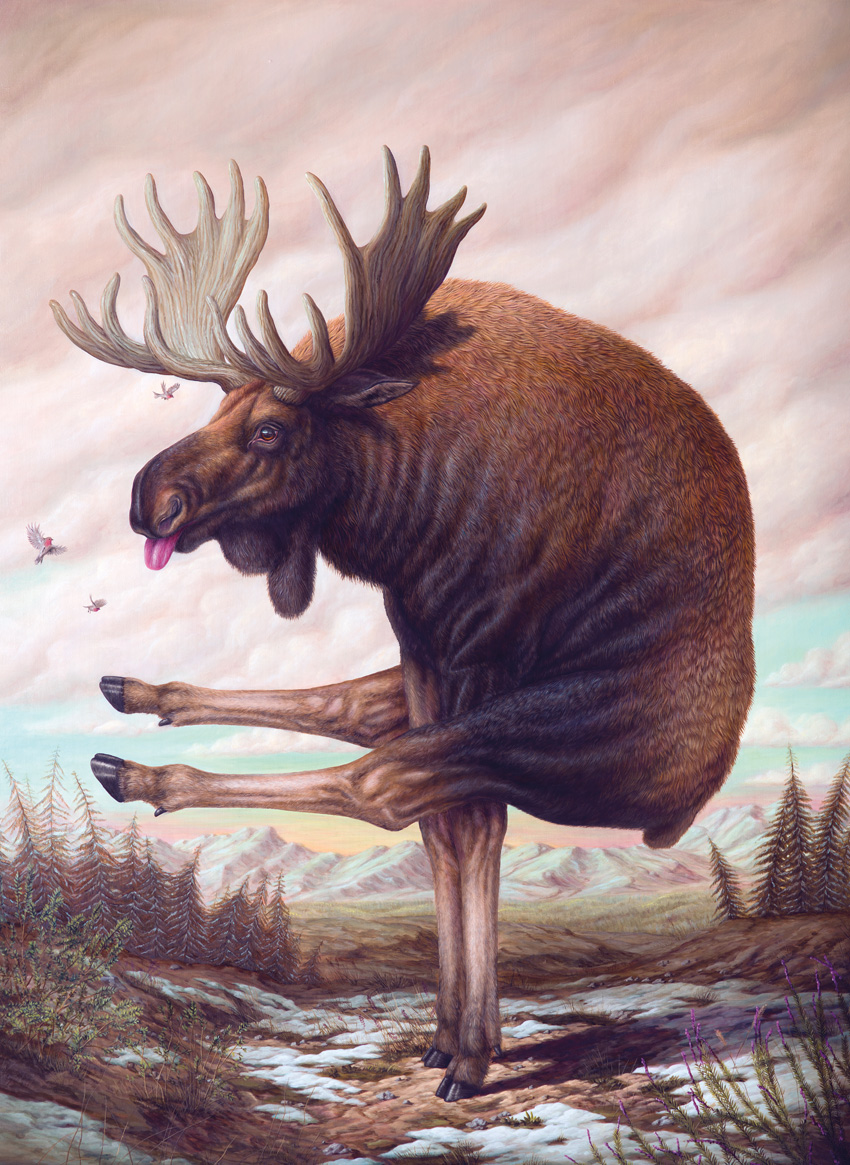
Twisted and stretched into almost comical shapes, the animals of French painter Bruno Pontiroli appear as true circus performers, in positions that defy the limits of what is physically possible. More than just extraordinary poses, his work is an invitation to question reality and imagine new worlds.
Naturally more at ease with the visual universe, Bruno Pontiroli uses painting as a means to explore distorted realities, where absurdity becomes the norm and the bizarre is indisputable. In unpredictable compositions, physical structures are called into question to give way to reinvented figures from the animal world, revealing the artist's motivation from early on: to seek in Art a way to challenge preconceived notions and offer a new perspective on reality. This set of principles translates into a play of shapes and colors designed to create a space open to multiple interpretations, without the immediate intention to shock, please, or disturb. The essential thing is to provoke a reaction — whatever it may be. For Pontiroli, the image has the power to communicate without words, to imagine without existing, and, above all, to reinvent the universe. In a conversation with Vogue Portugal that covers how the artist sees himself, the subtle elements he integrates into his works, and his relationship (or lack thereof) with the theme Animal Instinct, Pontiroli takes us behind the scenes of his creative universe and reminds us of the importance of questioning what we take for granted, almost without thinking.
Has painting always served as a creative outlet for you?
I've always been more comfortable with images than with words. I'm a rather introverted person, not always very comfortable with people, and I tend to withdraw and observe when I'm in a group. I clearly associate painting with a feeling of freedom. It’s a means of expression that suits me and in which I can easily be myself. In painting, there are only the constraints I impose on myself; I can set aside social expectations, rules and conventions that can be oppressive to me.
In several articles you’ve been described as a dreamer. Do you see yourself in that way?
I do have a hard time being in the present. When I am taking a break, sometimes just resting, my mind usually starts drifting and I start thinking about how things around me could be different. “What if?” is my usual companion. I guess my work is just an extension of this habit of mine to always challenge why things are the way they are and approach them from a different perspective. [...] In my work I focus on how they could be more fun and absurd.
Where do you draw inspiration from?
Most of my ideas come from letting myself draw freely. I then find shapes that I like, associations of ideas that seem interesting to me. Animals have inspired me the most in recent years. There is such a diversity of shapes and colors in the animal world; it's simply an endless source of inspiration. I also draw a lot of inspiration from nature drawings that illustrate and document our knowledge of animals. I have a few books that I like to leaf through and that allow me to fix images of animals in my mind, from which I can let my imagination run wild and play with shapes. I would say that inspiration comes from a mix of contemplation, reflection, and daydreaming.
When did you first begin drawing animals, and what led you to distort them and explore the absurd?
I began exploring the absurd long before I started painting animals. Painting reality as it appears to us has never interested me. The idea is for the viewer to recognize the subject and the fact that it doesn't conform to reality. I need to be surprised and amused by an idea in order to paint. I found in the absurd a form of freedom that allows and forces me to think differently. At first, I worked around themes like clouds or snowmen, which, like animals, possess a great deal of mystery and poetry, leaving room for all sorts of interpretations. About 7 or 8 years ago, I focused my subjects more, and then exclusively, on animals; they simply offer the opportunity to play with an infinite variety of shapes, colours, and textures.
What animal do you feel most represents you?
I never really thought about that, this is a very tricky question. I don’t believe I can compare myself to any specific animal other than maybe just Human, it would simply feel too presumptuous.
Could you describe your artistic process – from the initial idea to the finished product?
I first sketch my ideas on paper. I rework the ones I like before tracing a sketch onto a larger format, a canvas or a wood panel. I use oil paint because it dries slowly, allowing me to work all day without it starting to stretch. It also offers transparency possibilities that can give the painting a sense of depth. I paint my sketch with a single color that matches the subject (often an umber), and I focus on shapes and values. At this stage, I can project myself by imagining the colour palette I would use on the next step. I always work in stages, without too much detail at first. Gradually, I refine my painting by applying my colors and detailing certain areas more or less depending on what I want to emphasize. The hardest part is always determining when the painting is finished.
I read that your aim is to “turn the narrow vision that we have of the world upside down and disturb our imagination”. Why do you feel the need to do so?
I always try to look at things from different angles, in a sort of systematic questioning of what is. I believe it's a need for freedom that translates into bypassing what is conventional. We are accustomed to our environment, we know it well, and we end up, despite ourselves, no longer seeing things precisely because we are used to seeing them and they have become normal, part of the scenery. Through my work, I try to reinvent our universe by giving it new, different attributes, offering another set of rules. It’s back to my "what if?" companion.
What reactions are you hoping to provoke in your audience? Has there been a particular review of your work that was memorable?
They say a picture is worth a thousand words; I don't know if that's true, but in any case, my work has helped me realize how much impact an image can have on people. Sometimes my paintings disturb, sometimes they amuse or intrigue. Sometimes people feel disgust. Some people see my work as a message for the defense of animals, or on the contrary, that my work disrespects our beautiful nature. Others see it as a denunciation of overconsumption and the pollution of the earth. I've sometimes received insulting messages from people who found my paintings disrespectful. Fortunately, I also receive messages full of enthusiasm. A large number simply react to the ridiculousness and absurdity of it. To be honest, I'm not looking for a particular reaction, the important thing for me is that there is one.
On closer inspection of your paintings, certain unsettling hidden details emerge – for instance, in the background of "Le Mal de Mer #2" we see a figure being impaled. What meaning lies behind these elements?
I like to populate my canvases with elements that accentuate the bizarre and help me create a world in which everything is absurd. I also often use certain ideas in these backgrounds that I hadn't necessarily explored in a painting per se, or I borrow subjects from other paintings. This creates a connection between my paintings because we sometimes find recurring elements from one painting to another. A few years ago, I made a series of drawings in which I distorted the depiction of Jesus on the cross. [...] For me, it was a "gentle mockery" of religion in general, and I hadn't thought much further. I realized that these drawings, which for me were just a joke that we could call childish, and were perceived by others as an attack on their beliefs and identity. Which was obviously not what I wanted. The idea for me was to express my opinion on religion by denouncing the absurdity of some of its aspects, but I regret that these drawings may have offended some people.
This month’s theme for Vogue Portugal is Animal Instinct. How do you feel your work plays on this subject?
Strictly speaking, instinct is this thousands of years of ancestral experience that is passed on from one individual to the other and that ensures that the species survives in its environment, that they react efficiently without second thought to danger specifically. In nature, there is no room for contemplation, reflection or doubt; animals have always relied on their instinct and it is a big reason why they look like the animals we know today. So Animal yes definitely as they are the main characters in my paintings but Instinct... My work actually sort of does the opposite as it is based on questioning and challenging what is so natural and obvious for everyone. However, on second thought, associating my work and the idea of Animal Instinct opens a new dimension of the absurd which I find quite interesting. I mean, just imagine what king of instinct brings a tiger into a loop position?
What aspects of the relationship between humans and animals are you seeking to reveal or emphasize?
Personally, I believe that humans can be harmful to their environment, even though I'm putting it simplistically and the subject is much more complex. The animal world deserves our respect and our cherish. Human instinct has always been to exploit it as best we can for our own benefit, even to the point of upsetting the natural balance. That said, this personal conviction has no place in my work. I'm not trying to convey a message about the relationship between humans and animals or any political message. If I've occasionally combined several characters, human and animal, it was a play on shapes, a spontaneous association of ideas, not a conscious approach aimed at revealing or highlighting the relationship we have with animals or nature.
Lastly, how do you think your work will age over the years?
I like to think of my paintings as questions formulated in images, not answers, and that in these questions there is no notion of time, obsolescence, or aging. I believe and hope, that the bizarre, the absurd, and the dreamlike will continue to intrigue and provoke a reaction even if the style or the way they are represented may become outdated. Humanity will always need a certain element of dream.
Translated from the original in Vogue Portugal's The Animal Instinct Issue, published in September 2025. Full stories and credits are available in the print issue.
Most popular
Como terminar uma relação amorosa por mensagem, de acordo com o seu signo
19 Aug 2026
 By Inaya Mussa
All articles
Relacionados
Eye-maxxing: a técnica de beleza que realça o olhar de acordo com a teoria da cor
26 Aug 2026